Article: Engraving Drinkware in Batches: YETI, Glassware and Team Sets
Engraving Drinkware in Batches: YETI, Glassware and Team Sets
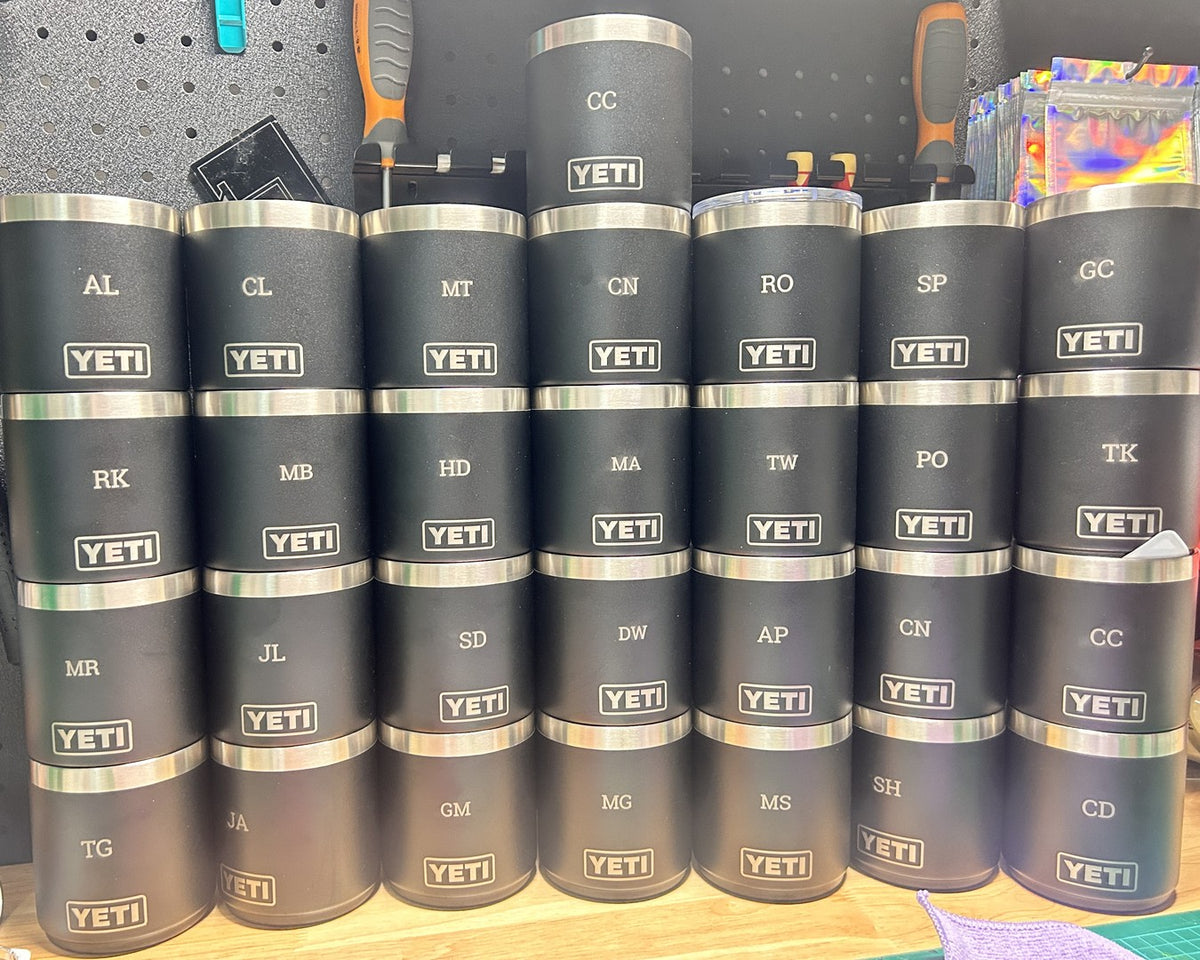
Engraving one cup is simple. Engraving twenty-eight cups, each with different initials, all matching and all going to the right person, is a different job. This month's bench has had a 28-piece YETI Rambler set for a team, a wedding order of several dozen glass tumblers, and a run of named bridal party tumblers. The laser does the same thing on every one of them. What decides whether a batch comes out right is everything around the laser.
This guide covers how batch drinkware engraving works: what the laser actually does to each material, where batch orders go wrong, and how to send an order so yours doesn't.
What the laser does to each material
Powder-coated stainless (YETI, Frank Green and similar)
Most insulated tumblers and bottles are stainless steel with a powder-coat finish. The laser takes the coating off along the lines of the design and leaves the steel showing underneath. Nothing is printed and there's no ink to wear, so the mark lasts as long as the coating around it.
How much the mark stands out depends on the colour of the coating. Silver steel against black, navy or a dark colour stands out a long way. Against white or a pale pastel it's more subtle: a soft silver-grey that looks clean up close but reads less from across a room. If the mark needs to be seen from a distance, pick a dark cup.
Bare stainless steel
Uncoated steel has no coating to take off, so it's marked instead. Our UV laser can leave a dark mark directly in the steel surface. We've run marked stainless cutlery through repeated dishwasher cycles and it came out unchanged, so for hospitality ware (cutlery, bar tools, kitchen equipment) the mark stands up to commercial washing.
Glass
On glass, the UV laser frosts a fine layer of the surface. The result is the white, etched look you see on engraved wine glasses and tumblers. It's in the glass itself, so there's nothing to peel or fade.
Glassware isn't flat, and that used to be the limit. A curved bowl moves in and out of focus across the width of a design, and a fixed-focus laser gives a mark that's sharp in the middle and soft at the edges. Our 3D UV system adjusts focus as it goes, following the curve of the glass, so a logo or a line of names stays sharp across the face of the glass instead of just a narrow strip.
A few kinds of glass get a test before we quote. Toughened and tempered glass, including the certified glasses many venues have to use, is usually fine under a UV laser, but we test a sample first rather than find out partway through a box. Polycarbonate and other "unbreakable" plastic drinkware goes cloudy under the laser, so we don't recommend it for engraving.
Where batch orders go wrong: the list
On a batch job the engraving is the easy part. Nearly every problem with a batch order starts in the names list.
- Duplicate entries. The 28-cup YETI set had two people with the initials CC and two with CN. Doubled entries are how a set comes back with one person missing and someone else holding two. We check every line off against a finished item, and the count has to land exactly on the order quantity with nothing left over.
- Spelling and capitals. We engrave exactly what's on the list. "Mcdonald" and "McDonald" are both somebody's name, so we won't guess which one you meant.
- Lists sent in pieces. A list pasted into an email body, then corrected in a reply, then corrected again, is how an old spelling ends up on the glass. Send one final list as a spreadsheet, with one row per item.
For a wedding or event with a fixed date, send the list early. Names are the part that changes, and a change after engraving means a new blank.
Consistency across the set
In a set, the mistake people spot isn't a flaw in one engraving. It's one item that doesn't match the others. If one name sits 2 mm higher, or one cup's text is a touch larger because the name was longer, it's the first thing anyone notices when the set is lined up on a table.
So a batch is set up once and run the same way throughout: one font, one letter height, and a fixed position measured from the rim or base, with every item seated in the same spot on the machine. Longer names fit the same height band rather than being shrunk to fit a width. If a very long name won't fit at the set height, we raise it with you before cutting, instead of quietly making that one smaller.
Script fonts at small sizes
Script lettering suits weddings and gifts, and it's also the style most likely to struggle when small. Fine hairlines and tight loops can close up once the letters get very small, especially on a curved glass. If a design is headed for a narrow tumbler or a champagne flute, we'll tell you if the script needs to go up a size or be swapped for a more open face. It's the same floor we hit when cutting fine lettering into stencils.
Bring your own, or we source the blanks
Both work. If you already have the bottles or tumblers, such as a team order bought through a club or a set of YETIs you've picked out, our BYO drink bottle and tumbler engraving covers it. For glassware we can source the blanks, which also means every glass in the order comes from the same production run and matches.
How to send a batch order
- One spreadsheet, one row per item, spelled exactly as it should appear.
- Your artwork or logo, if there is one. Vector (PDF, SVG, AI) is best, but a clean high-resolution image works for most jobs.
- The drinkware: the brand and model if you're supplying it, or the style you want if we're sourcing it.
- Your date, if there's an event.
Send it through our quote request form and we'll come back with a proof of one item for sign-off before the batch runs. You can browse finished work in our engraved drinkware range.
Tinkable engraves in Brisbane on CO2 and UV lasers, for teams, clubs, venues, weddings and businesses across Australia.

Leave a comment
This site is protected by hCaptcha and the hCaptcha Privacy Policy and Terms of Service apply.