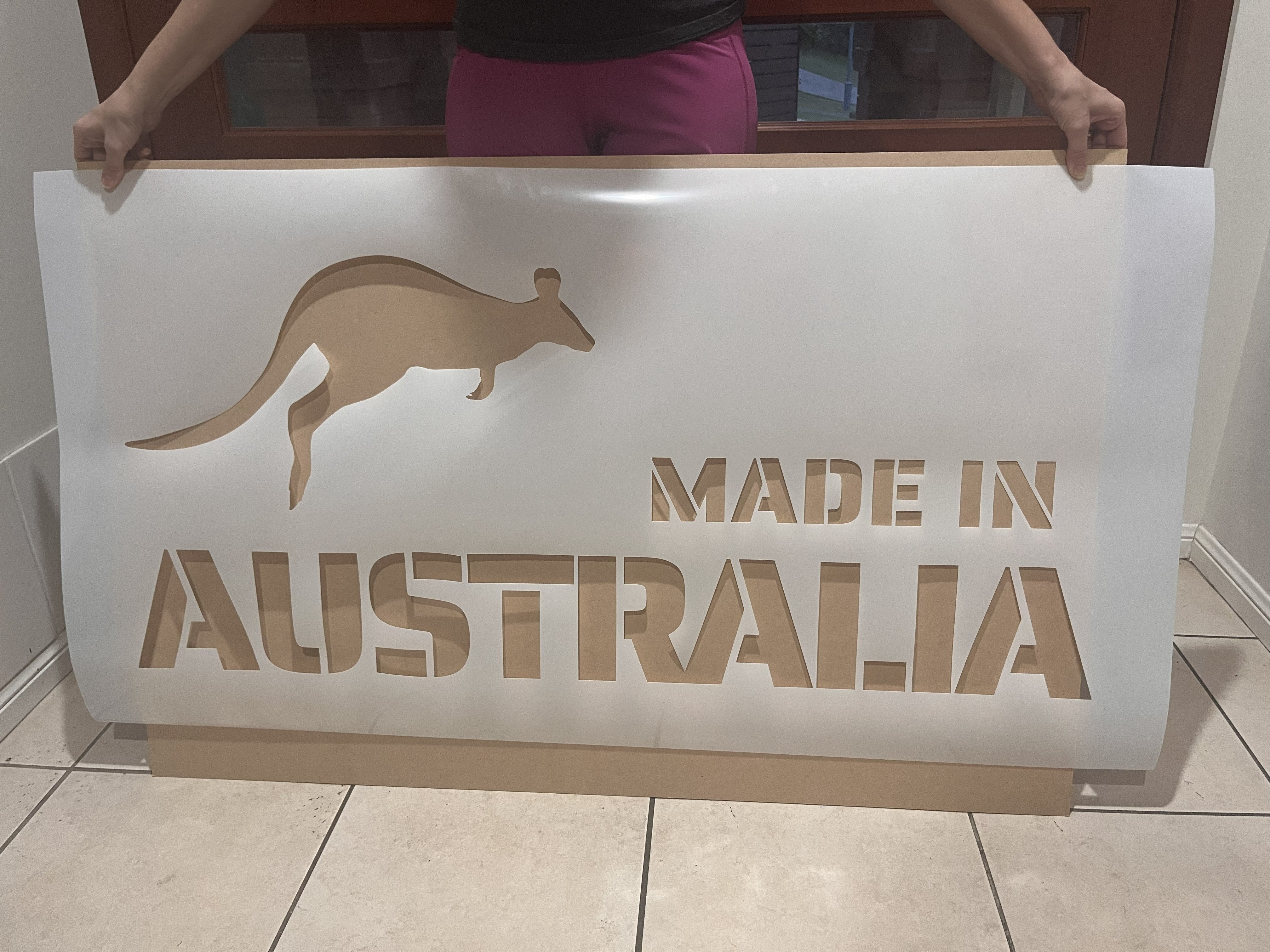
Choosing the Right Stencil Thickness
Thickness is one of the most overlooked stencil specs, but it has a real effect on how crisp your finished result looks and how long the stencil lasts. Here's how to pick the right one.
Thin stencils (around 0.05mm–0.13mm)
Thin stencils sit close to the surface, which helps produce crisp, fine detail with minimal paint bleed underneath the edges. They're well suited to detailed artwork, fine text, and single or occasional use. The trade-off is durability — thin material is more prone to tearing with heavy or repeated handling.
Medium stencils (around 0.19mm–0.25mm)
This is the most common range for general-purpose stencils. It balances edge sharpness with enough rigidity to hold up over dozens of uses, making it a solid default for most signage, crafts, and small business marking jobs.
Our thinner Mylar is 0.19mm, at the fine end of this band. It is the thickness we recommend for intricate artwork and anything going onto a curved surface, where the stencil needs to flex without creasing.
Thick stencils (0.3mm and above)
Thicker material is built for heavy, repeated industrial use — think warehouse crate marking, concrete stamping, or road and pavement marking where the stencil gets dragged, walked on, or exposed to the elements. It holds its shape under rough handling but is less suited to fine detail, since the extra thickness makes crisp edges harder to achieve.
Our Commercial Mylar is 0.35mm, roughly twice the strength of the 0.19mm. It is the default recommendation for spray painting, site work, and anything you expect to reuse regularly. For genuinely rigid large-format work we also cut MDF and plywood.
When rigid beats thin: coffee stencils
Coffee and cocktail stencils are the exception to the "thinner for detail" rule. Our main material there is 3mm acrylic, because a rigid stencil rests flat across the rim of the cup instead of sagging toward the crema — which keeps the dusted edge sharp and the result identical from cup to cup. It also survives constant washing without curling. See coffee stencils for cafés and events for the detail.
Matching thickness to your project
| Use case | Recommended | What we would supply |
|---|---|---|
| Fine art, detailed logos | Thin | 0.19mm Mylar |
| General signage, branding | Medium to thick | 0.19mm or 0.35mm Mylar |
| Coffee and cocktail | Rigid | 3mm acrylic, or 0.35mm Mylar |
| Warehouse, industrial, outdoor | Thick | 0.35mm Mylar |
A quick rule of thumb
The more detailed the design, the thinner the stencil should be. The more punishing the environment or the more times it will be reused, the thicker it should be. When a project needs both fine detail and heavy reuse, a mid-range mylar stencil is usually the best compromise — unless the stencil sits on a cup, in which case rigid acrylic wins.
Ordering
Thickness is a selectable option on our custom Mylar stencils, our large custom stencils for walls and floor marking, the text stencil designer, and the coffee and cocktail stencils. If you are still weighing up materials rather than thickness, start with Mylar versus polypropylene. Every order is proofed before cutting, so if you pick the wrong one we will flag it before it becomes a problem.

Written by Katharine Huth

Leave a comment
This site is protected by hCaptcha and the hCaptcha Privacy Policy and Terms of Service apply.